
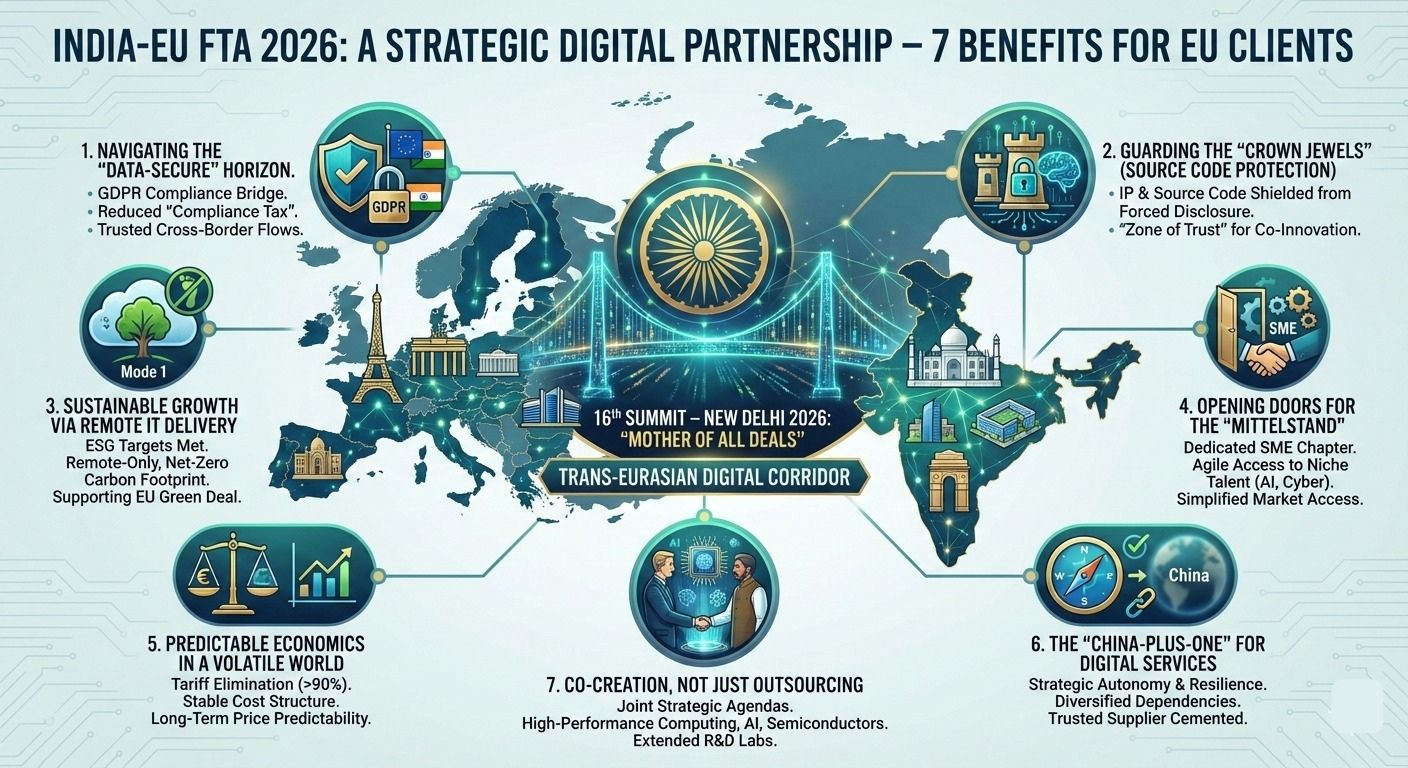
The conclusion of the India–EU Free Trade Agreement (FTA) in January 2026, celebrated at the 16th India–EU Summit in New Delhi, has fundamentally rewritten the playbook for digital collaboration.
As an industry practitioner observing these shifts firsthand, I can confidently say this deal goes far beyond tariff reductions. It signals the emergence of a Strategic Digital Partnership—one built on trust, regulatory alignment, and long-term resilience.
At our firm, we’ve leaned fully into a remote-only delivery model. While the FTA simplifies professional mobility (Mode 4), we believe the future of digital sovereignty for European clients lies in high-integrity, remote-first engineering that minimizes carbon footprints and operational overhead.
Below are 7 humanized, European-centric benefits of what many are calling the “Mother of All Deals.”
1. Navigating the “Data-Secure” Horizon
The most common question I hear from European CIOs is simple but critical:
“Can we stay GDPR-compliant while working with India?”
The 2026 FTA creates a clear pathway toward India achieving “data-secure” status under EU law.
The Reality:
This alignment dramatically reduces the compliance tax on European legal and governance teams. In our remote workflows, we’ve already embedded these frameworks—making cross-border data transfers feel as seamless as moving data between Berlin and Lyon.
2. Guarding the “Crown Jewels” (Source Code Protection)
In earlier years, concerns around mandatory technology transfer held many European firms back.
The FTA now explicitly protects software source code from forced disclosure.
The Strategic Edge:
European companies can co-innovate with Indian partners without fear of IP leakage. This newly created “Zone of Trust” is essential for deep R&D and engineering (ER&D) collaborations.
3. Sustainable Growth Through Remote IT Delivery
European enterprises are under increasing pressure to meet ESG (Environmental, Social, and Governance) goals.
The Experience:
Our remote-only delivery model eliminates carbon-intensive travel associated with traditional on-site consulting. The FTA strengthens Mode 1 service delivery, positioning offshore IT services as a genuine enabler of the EU Green Deal.
Remote delivery is no longer a workaround—it’s a sustainability strategy.
4. Opening Doors for the “Mittelstand” (SME Focus)
For years, India felt accessible mainly to the Fortune 500. That changes now.
The FTA introduces a dedicated SME Chapter designed to simplify market access.
The Benefit:
Europe’s Mittelstand can now tap into niche Indian expertise—AI architects, cybersecurity specialists, cloud engineers—without massive legal or operational overhead. We’ve intentionally designed our remote engagement models to support agile, high-precision SME teams.
5. Predictable Economics in a Volatile World
With inflation and geopolitical shifts, long-term IT budgeting has become increasingly difficult.
The FTA eliminates or reduces tariffs on over 90% of trade value, creating a more stable cost environment.
The Trust Factor:
By removing hidden service levies and streamlining customs for tech-related hardware, we can offer multi-year pricing predictability. This gives European CFOs the confidence to plan digital transformations on three-to-five-year horizons.
6. The “China-Plus-One” Strategy for Digital Services
Strategic autonomy is now a central theme in Brussels.
Partnering with **India—a democratic, rules-based economy—**allows Europe to diversify its digital supply chains.
Why It Matters:
In our experience, European clients are no longer searching for cheap code. They want resilience, continuity, and trust. The FTA firmly establishes India as a trusted supplier within the global digital value chain.
7. Co-Creation, Not Just Outsourcing
The industry is moving beyond “tickets and tasks.”
The FTA actively encourages collaboration in AI, high-performance computing, semiconductors, and deep tech.
The Human Element:
Our remote teams don’t just fix bugs—they operate as an extension of your R&D lab. This depth of integration is possible only because the FTA harmonizes professional standards and enables mutual recognition of qualifications.
The 2026 Perspective: A Trans-Eurasian Digital Corridor
The EU–India FTA isn’t a magic wand—but it is a durable foundation.
By combining India’s scale with Europe’s precision, delivered through a secure, remote-first model, we are witnessing the rise of a true Trans-Eurasian Digital Corridor.
For European enterprises seeking compliant, sustainable, and future-ready digital partnerships—the moment is now.